
Blog
How to Write a Handyman Estimate (Free Template)

A customer sends three photos of a sagging fence and asks “roughly how much?” Say a number on the spot and you’ll either undercharge or lose the job when the real price turns out higher. A written handyman estimate protects both sides: the customer knows exactly what they’re paying for, and you have a clear record when “while you’re here, could you also…” comes up.
Below is what to put in a handyman estimate, how to work out the numbers, a free template you can copy, and the mistakes that lead to unpaid extras and awkward conversations.
Key takeaways
- An estimate is your best written guess of the price for a defined scope. Put it in writing before you start, every time.
- Every estimate needs: your details, the customer’s details, a clear scope, labor, materials, exclusions, how long the price is valid, and how the customer approves it.
- Any extra work gets its own written approval before you do it.
In this guide
Estimate, quote or invoice: what’s the difference?
People use these words loosely, so define them in your own paperwork:
| Document | What it is | When you send it |
|---|---|---|
| Estimate | Your expected price for a described job. It may change if the job turns out different from what was described. | Before the work, after seeing photos or the site |
| Quote | A fixed price for a fixed scope. If nothing changes, that’s the price. | Before the work, when the job is predictable |
| Invoice | A request for payment for work done, with any deposit already paid deducted. | After the work, or at agreed stages |
Many handymen send an estimate that says clearly when the price can change, and turn it into a fixed quote for jobs they do every week. Whichever you use, say which one it is at the top of the document.
What to include in a handyman estimate
Here’s what goes on every handyman estimate, from a single faucet swap to a full day of drywall and caulk repairs:
- Your business details: name, phone, e-mail, website and any license or registration number your area requires.
- Customer details: name, address of the job and how to reach them.
- Estimate number and date, so you can find it later and refer to it on the invoice.
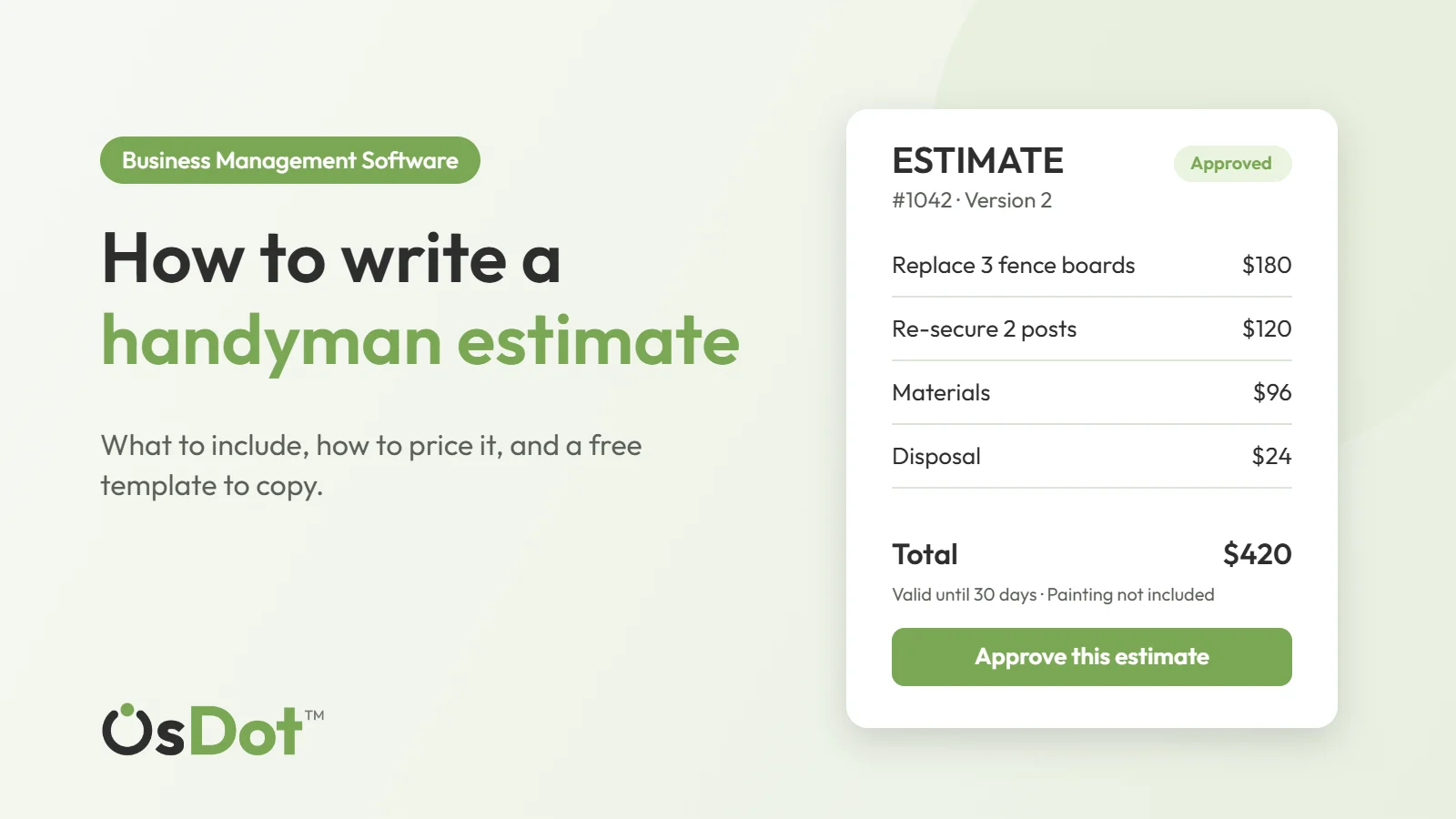
- Scope of work, written so a stranger would understand it: “Replace 3 rotten fence boards (approx. 6 ft each) and re-secure 2 loose posts on the left side of the back garden.”
- Labor: hours and rate, or a flat price per task.
- Materials: each item as its own line item with quantity and price, or one materials line if you prefer, and whether disposal and cleanup are included.
- Exclusions: what you’re not doing (“Painting or staining not included”; “Price assumes posts are sound below ground”).
- Taxes, if you have to charge them where you work, shown on their own line.
- Deposit and payment terms: for example, a deposit to book and the balance on completion.
- Valid until: prices for materials move; 14 or 30 days is common.
- Approval: a signature, a written “yes” by e-mail, or an online approval button. Without it, you don’t have an agreement.
Never start work on a verbal “go ahead” for anything beyond a tiny job. If the customer disputes the price later, the written, approved estimate is your evidence.
How to work out the numbers
Labor. The labor line is where most handyman prices go wrong. Estimate the hours on site for the handyman job, then add the time people forget: loading the van, travel, a trip to the hardware store, set-up and clean-up. If you work to a minimum charge, apply it here.
Materials. Price each item from your supplier and add a markup that covers the time you spend buying, collecting and returning materials, plus waste. Some handymen show materials at cost and charge for the shopping time instead; choose one way and be consistent.
Contingency. For older homes and hidden work (behind tiles, under flooring), either add a line for “possible additional repairs, priced on approval” or state the assumption in the exclusions. Don’t hide a cushion in the labor line.
Check the total against the job. If the number surprises you, it’ll surprise the customer. Look again at the scope; maybe it should be split into two jobs, or offered with a simpler option.
Free handyman estimate template
Copy this into your document or invoicing tool, fill in the brackets, and save it as a PDF to send.
ESTIMATE  #[number]                      Date: [date]
[Your business name] · [phone] · [e-mail] · [license or registration no., if required]

Customer: [name]
Job address: [address]
Contact: [phone / e-mail]

SCOPE OF WORK
[Describe each task clearly, one per line, with sizes and locations]

LABOR
[Task or hours] × [rate] ......................... [amount]

MATERIALS
[Item] × [qty] @ [price] ........................ [amount]
Disposal of old materials ........................ [amount / included]

Subtotal ......................................... [amount]
Tax ([rate], if applicable) ...................... [amount]
TOTAL ESTIMATE ................................... [amount]

NOT INCLUDED
[Exclusions and assumptions]

TERMS
Deposit to book: [amount]. Balance due on completion.
Any additional work is priced and approved in writing before it is done.
This estimate is valid until [date].

APPROVAL
I approve this estimate.  Name: ________  Signature / date: ________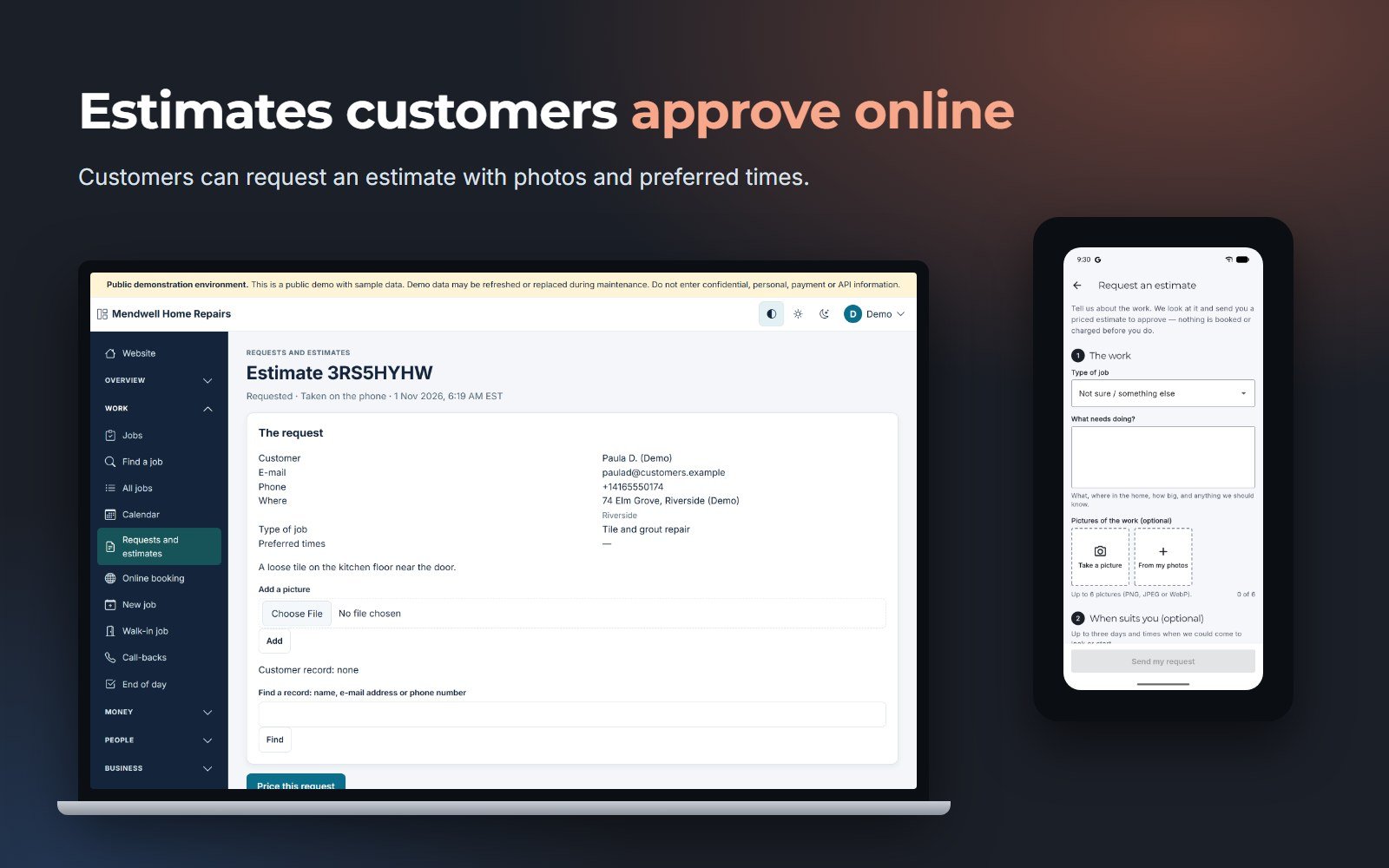
When the job changes: added work and new versions
Jobs change. You open the wall and find a rotten joist; the customer decides they also want the gate rehung. Handle it the same way every time:
- Stop and explain the change, with a photo if it helps.
- Send a revised estimate (version 2) or a separate estimate for the added work, with the new total.
- Get the customer’s approval of that version before you continue.
Numbering versions matters. If version 1 was $480 and version 2 is $620, both of you should be able to see which one was approved and when. It ends most payment disputes before they start.
Common estimate mistakes
- Vague scope. “Fix fence” invites an argument about whether the posts were included.
- No exclusions. Customers assume everything is included unless you say otherwise.
- No expiry date. Six months later, material prices have changed, and so has your schedule.
- Forgetting travel and shopping time. It’s real time; price it.
- Starting before approval. A text that says “sounds good” is weaker than an approved estimate.
- Mixing all your handyman services into one line. Separate line items make it easy for the customer to see what they’re paying for, and to approve part of the job if the total is too high.
- Sending it too late. Customers often hire whoever sends a clear price first. Aim to send estimates the same day.
The easier way: estimates in Handyman Booking OS
Writing estimates in a word processor works until you’re sending ten a week. That’s when handyman estimating software earns its place. Handyman Booking OS keeps estimates, jobs and invoices together for one small home-repair business:
- Customers request an estimate with photos and their preferred times on your own website or in the app.
- You send versioned estimates, and the customer approves a specific version online.
- Added work needs the customer’s approval before it’s done.
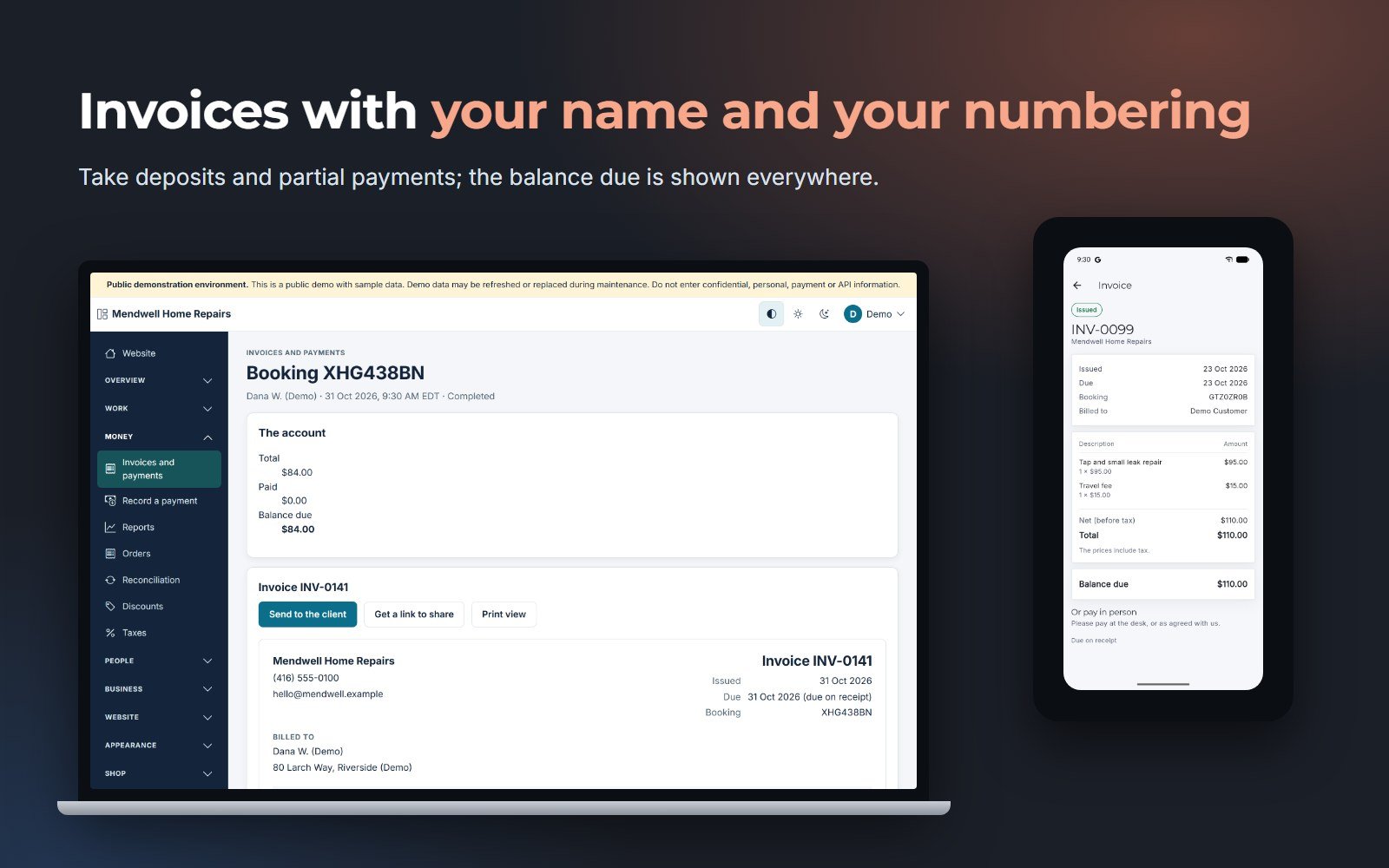
- Scheduling and invoices are in the same product: invoices carry your business name, numbering and tax lines, with deposits, partial payments and the balance due shown everywhere.
OsDot™ · Own the OS. Run Your Business.
Handyman Booking OS
- Estimate requests with photos, versioned estimates and online approval
- Scheduling for your own workers and one app for customers and workers
- Invoices, deposits and online payments on your own accounts
- Buy & Own from $67 one-time, or a Hosted Plan from $12 a month
FAQ
Should handymen charge for estimates?
Most give free estimates for normal jobs, because it wins work. Some charge a small fee for long site visits or complex jobs and take it off the final bill if the customer goes ahead. State your policy before you visit.
How long should a handyman estimate be valid?
14 to 30 days is common. Material prices and your schedule change, so put a clear valid-until date on every estimate.
Can the final price be higher than the estimate?
Only for work that wasn’t in the scope, and only after the customer approves a revised estimate. If the scope doesn’t change, keep to your price.
What’s the difference between an estimate and a quote?
An estimate is your expected price and can change if the job turns out different. A quote is a fixed price for a fixed scope. Say which one you’re giving at the top of the document.
Do I need software to send estimates?
Not at first; a clear template works. Software helps once you send several estimates a week, need customers to approve them online, or want approved estimates to turn into jobs and invoices automatically.
Send your next estimate today
Copy the template, fill in your business details once, and use it for your next job. Write the scope so a stranger could understand it, add your exclusions and an expiry date, and don’t start until you have approval. If you’d like the whole flow online, from the customer’s request with photos to the paid invoice, have a look at Handyman Booking OS.
Starting out? Read our guide on how to start a handyman business. For more guides, join the OsDot newsletter.