
Blog
Salon No-Show Policy: How to Write One (Template)


A client books a two-and-a-half-hour colour for Saturday morning and doesn’t turn up. That chair sat empty for the most valuable hours of your week, and the clients you turned away booked elsewhere. A clear salon no-show policy won’t stop every missed appointment, but it changes how clients treat a booking, and it gives you a fair, agreed way to handle the ones that happen.
This guide covers what a good salon no-show and cancellation policy includes, a template you can adapt, how to enforce it without losing good clients, and the habits that prevent most no-shows in the first place.
Key takeaways
- Define the terms: what counts as a no-show, a late cancellation and a late arrival.
- Protect long and expensive services with a deposit, and set a cancellation deadline (24 or 48 hours is common).
- Show the policy before the client books, in the confirmation and in the reminder. Surprises cause arguments.
- Reminders do more than fees: in healthcare research, text reminders raised attendance from about 68% to 79%.
In this guide
- Why your salon needs a no-show and cancellation policy
- What to include in a salon no-show policy
- Salon no-show and cancellation policy template
- How to communicate it so clients actually read it
- How to enforce it without losing good clients
- How to prevent no-shows in the first place
- The easier way: Salon Booking OS
- FAQ
- Put your policy in place this week
Why your salon needs a no-show and cancellation policy
Most no-shows and last-minute cancellations aren’t malicious. People forget, double-book themselves or feel awkward about cancelling. But each one costs you the service price, the stylist’s paid time and the chance to give that slot to someone else.
For a salon owner, a written policy does three things. It tells clients a booking is a commitment. It gives your team one rule to apply, instead of deciding case by case at the front desk. And it lets you take deposits or charge fees in a way clients agreed to in advance.
What to include in a salon no-show policy
| Part of the policy | What to decide | Common choice |
|---|---|---|
| Cancellation deadline | How long before the appointment clients can cancel or move it for free | 24 hours; 48 hours for long colour or bridal services |
| Late cancellation | What happens if they cancel after the deadline | Deposit kept, or a cancellation fee as a percentage of the service price |
| No-show | What happens if they don’t come and don’t tell you | Deposit kept, or a fee; repeat no-shows must pay in full to book again |
| Late arrival | How late is too late | After 15 minutes the service may be shortened or rebooked |
| Deposits | Which services need one, and how much | Long or high-value services only, so regular clients aren’t put off |
| Exceptions | When you’ll waive it | Emergencies, illness, a first offence for a loyal client; at the manager’s discretion |
| How it’s shown | Where clients see it | Booking page, confirmation, reminder and your website |
Keep it short. A client should understand the whole policy in under a minute. Many no-show policies fail because they read like a contract; yours should read like a friendly note.
Salon no-show and cancellation policy template
Adapt the times and amounts to your salon, then put it on your booking page and in your confirmation messages.
APPOINTMENT AND CANCELLATION POLICY

We keep your appointment time just for you. If you need to cancel or
reschedule, please let us know at least [24] hours before your appointment.
You can do this yourself from your booking confirmation or by calling us.

Deposits: [Colour, balayage and treatments over 90 minutes] need a deposit of
[amount or %] when you book. It counts towards your bill.

Late cancellations: if you cancel less than [24] hours before, your deposit is
kept. For services without a deposit, we may charge [amount or %] of the
service price.

No-shows: if you miss your appointment without telling us, your deposit is
kept. After [2] missed appointments, we'll ask for full payment when you book.

Running late: please call us. If you arrive more than [15] minutes late, we may
need to shorten your service or move your appointment.

We understand that emergencies happen. Please talk to us, and we'll always try
to be fair.
Write the policy in your salon’s own voice. “We keep your appointment time just for you” lands better with clients than “Failure to attend will result in a penalty.”
How to communicate it so clients actually read it
Clients accept rules they saw before they booked. They argue about rules they discover afterwards.
- On the booking page, show the cancellation deadline as an actual date and time (“Free changes until Friday 14 November, 10:00”), not just “24 hours”.
- Before payment, state the deposit and when it’s refunded.
- In the confirmation, repeat the deadline, the deposit and the balance due at the salon.
- In the reminder, add a one-line note: “Need to change? You can reschedule free until [deadline].”
- At the front desk, give phone and walk-in clients the same summary. One policy for every channel.
How to enforce it without losing good clients
A policy only works if you apply it consistently, but rigid enforcement can cost you a client who’s spent thousands with you. A few rules of thumb:
- Automate the routine part. If the deposit and deadline are handled by your booking system, nobody at the desk has to argue about money.
- Give managers a waiver. Let them waive a fee for a genuine emergency or a first miss by a loyal client, and keep a note of it.
- Track repeats. The real problem is usually a small number of clients who miss again and again. Ask those clients for full prepayment.
- Never shame anyone. Neutral wording (“We missed you today; your deposit has been applied as per our policy”) keeps the door open.
How to prevent no-shows in the first place
Fees and deposits deal with no-shows after they happen. These habits stop many of them happening at all:
- Send reminders. It’s the best-evidenced fix. A Cochrane review of seven trials in healthcare found attendance of 78.6% with text message reminders against 67.8% without. Salon clients forget for the same reasons patients do.
- Make it easy to cancel or reschedule. If moving an appointment takes one tap, clients move it instead of just not showing up.
- Ask clients to confirm. A quick call or message the day before gives you time to fill the slot if they’ve changed their mind.
- Take deposits on the services that hurt most. You don’t need a deposit on a 20-minute fringe trim.
- Collect working contact details. You can’t remind a client whose phone number has a typo.
The easier way: Salon Booking OS
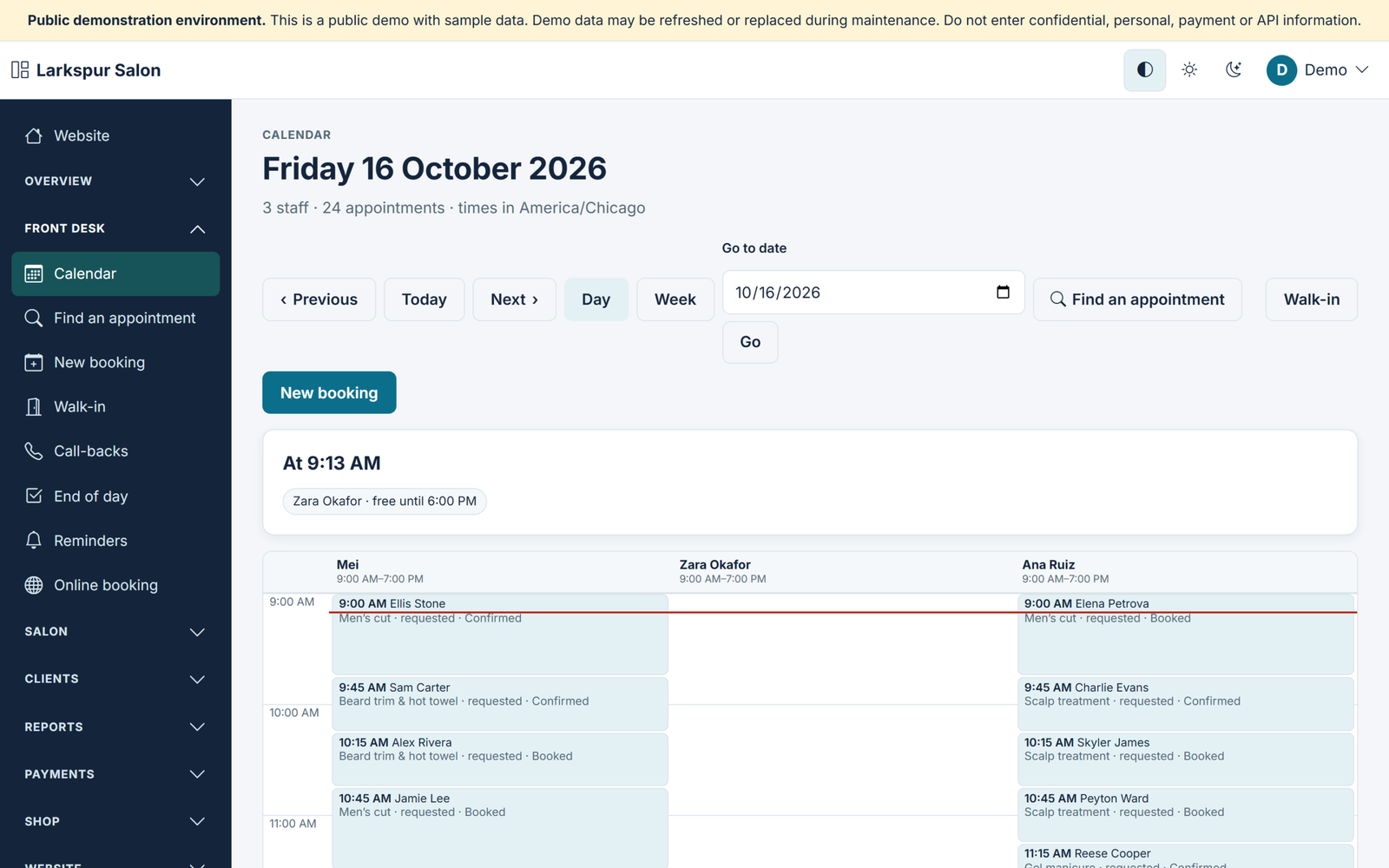
Salon Booking OS builds these habits into the booking itself:
- Deposits on the services you choose, collected online through PayPal, Stripe or Razorpay on your own accounts; the balance is paid at the salon.
- Every confirmation shows the booking reference, time, stylist, total, deposit, balance and cancellation deadline, with an add-to-calendar file and directions.
- E-mail reminders, each sent at most once, with quiet hours so clients aren’t messaged at night.
- Clients can reschedule or cancel themselves before your deadline, and the front desk has a call-back list for confirming bookings by phone.
- When an appointment is cancelled, the client always gets a cancellation notice.
OsDot™ · Own the OS. Run Your Business.
Salon Booking OS
- Online booking with deposits and a clear cancellation deadline
- E-mail reminders and a front-desk call-back list
- One staff calendar that never double-books
- Buy & Own from $67 one-time, or a Hosted Plan from $12 a month
FAQ
Is it legal to charge a no-show fee at a salon?
In many places it is, as long as the client agreed to the policy before booking and the fee is reasonable. Rules on deposits and cancellation charges vary by country and state, so check your local consumer rules and show the policy clearly at booking.
How much should a salon charge for a no-show?
Many salons keep the deposit, or charge a share of the service price, and ask repeat no-shows to pay in full when they book. Salon cancellation fees should cover your loss without feeling like a punishment.
Should every service need a deposit?
Usually not. Deposits work best on long or expensive services, such as colour, balayage or bridal work. Short regular services rarely need one, and asking for it can put loyal clients off.
How far in advance should clients cancel?
24 hours is the most common deadline, and 48 hours is common for long or high-value services. Show the deadline as an actual date and time in the confirmation.
Do reminders really reduce no-shows?
Yes. Studies in healthcare, where it’s been measured most, show reminders raise attendance noticeably. A reminder with an easy way to reschedule works better than a fee alone.
Put your policy in place this week
Decide your deadline, which services need a deposit and what happens after a miss. Write it in your salon’s voice using the template, then add it to your booking page, your confirmation and your reminder. Set up reminders if you haven’t already; they’ll do more for your Saturday mornings than any fee.
Setting up online booking too? Read our guide to setting up a salon online booking system. For more guides, join the OsDot newsletter.