
Blog
How to Ask Customers for Reviews (Templates + AI)

Your happiest customers almost never write a review on their own. They mean to, then the day gets busy. Meanwhile the one customer who had a bad experience finds the time. The fix isn’t luck; it’s asking, at the right moment, in a way that takes them thirty seconds.
This guide covers how to ask customers for reviews, on Google and other review sites such as Yelp or Facebook: when to ask, what to say (with templates you can copy), the rules you mustn’t break, and how to automate the asking so it happens after every job without anyone remembering to do it. It also includes AI prompts to write your requests and replies faster.
Key takeaways
- Ask soon after a good visit or job, while the experience is fresh, and send a direct link so it takes seconds.
- Ask every customer, not only the ones you think are happy. Filtering who you ask breaks Google’s rules.
- Never pay or reward customers for positive reviews. In the US it’s banned by the FTC’s rule on fake reviews.
- Reply to reviews, good and bad: in BrightLocal’s 2026 survey, 89% of consumers expect owners to respond.
In this guide
Why asking works
Reviews matter to people choosing a local business. In BrightLocal’s Local Consumer Review Survey 2026, 97% of consumers said they read reviews for local businesses, and 74% look for reviews written in the last three months. The same survey found that 78% had been asked to write a review in the past year, and most of those who were asked went on to leave one.
Online reviews are how potential customers judge a local business before they call. So it pays to ask for reviews: asking is normal, it works, and recent reviews count more than a pile from two years ago. That’s an argument for asking steadily, after every job, rather than in a burst once a year.
When to ask for a review
Ask when the customer has just experienced the result:
- Salons: the same day as the appointment, once the client is home and has seen the finished look in their own mirror.
- Handymen and home services: right after the job is marked complete, while the fixed door or the mounted TV is still new.
- Shops: after the order has been delivered or collected, not when it’s dispatched.
Don’t ask before the work is done, and don’t ask three times. One request and, at most, one gentle reminder a few days later is plenty.
Ways to ask for reviews that work
| Method | How | Good for |
|---|---|---|
| In person | Mention it at the end of the visit: “If you’re happy with it, a quick review really helps us.” | Building the habit; works best combined with a follow-up link |
| A short message with one button that opens the review form | Every customer, automatically after each job | |
| Text message | Two lines and a short link | Customers who don’t read e-mail; check consent rules where you are |
| QR code | A small card or counter sign that opens your review page | Salons and shops with a front desk |
Whichever way you ask your customers, make it one tap. Every extra step, such as “search for us on Google, then find the reviews tab”, loses people.
What to say: review request templates
Short, personal and specific beats long and formal. Use the customer’s name and mention the product or service they had.
E-MAIL AFTER A SALON APPOINTMENT
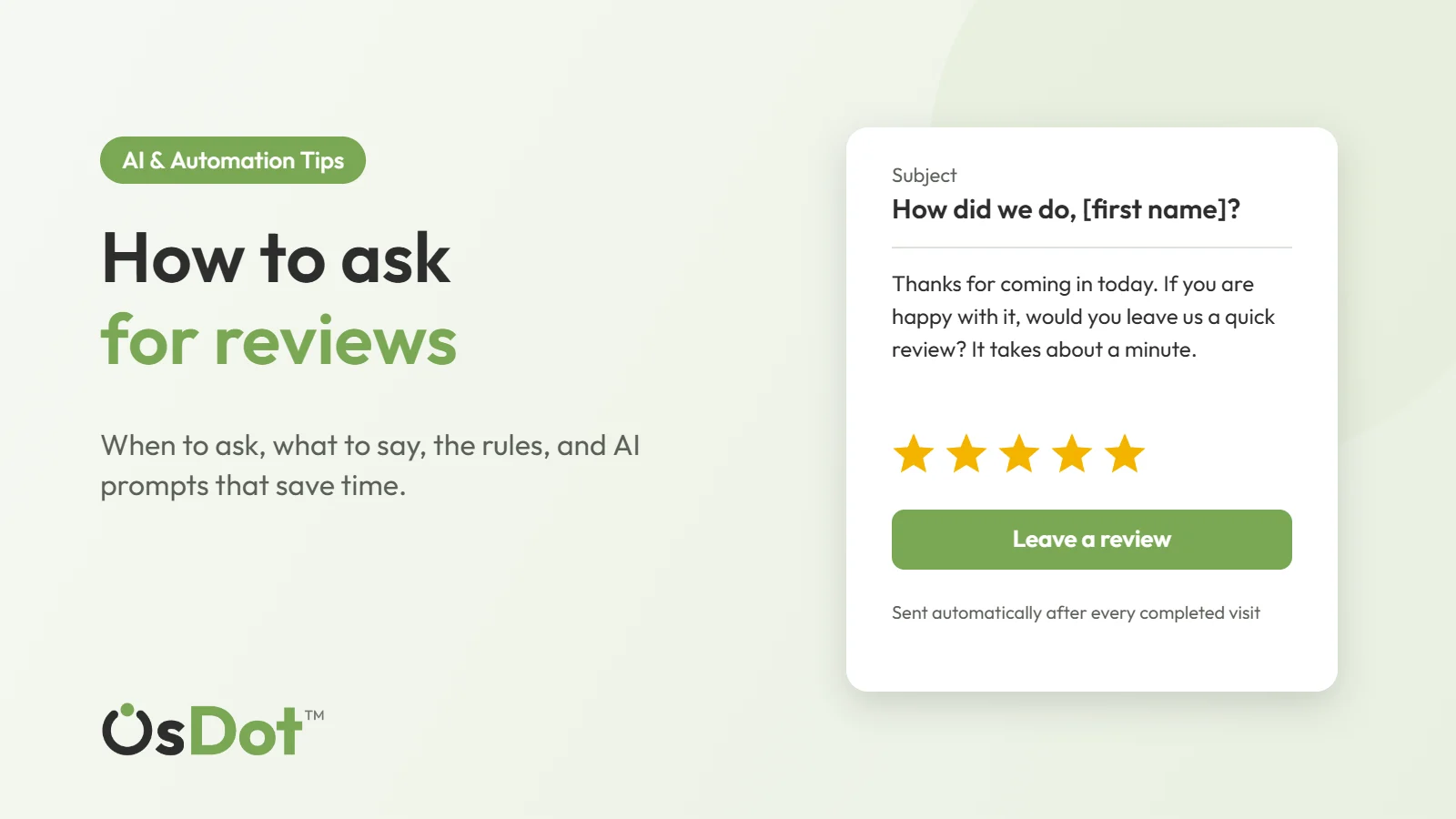
Subject: How did we do, [first name]?

Hi [first name],

Thanks for coming in today for your [service] with [stylist].
If you're happy with it, would you leave us a quick review? It takes
about a minute and helps other people find us.

[Leave a review]

Thank you,
[Salon name]
TEXT AFTER A HANDYMAN JOB
Hi [first name], thanks for having us fix your [job] today.
If you're happy with the work, a short review helps a small business
like ours a lot: [link]. — [Your name], [Business name]Avoid “If you were happy, please review us; if not, contact us first” in the same message. It reads like you’re steering unhappy customers away from the review page, which is the review gating Google prohibits.
The rules: what you must not do
Getting reviews the wrong way can get them removed, or worse.
- Don’t pay or reward reviews that say something nice. The US FTC rule on fake reviews and testimonials, in force since October 2024, bans incentives conditioned on a review’s sentiment, as well as fake reviews and reviews from undisclosed insiders.
- Don’t offer incentives for Google reviews at all. Google’s policy doesn’t allow paying or rewarding customers for reviews.
- Don’t ask only happy customers. Selectively asking (review gating) breaks Google’s rules. Ask everyone.
- Don’t write reviews yourself or ask staff and family to. Reviews must come from real customers.
- Don’t threaten or pressure people to remove negative reviews.
Outside the US, consumer protection rules in many countries say much the same. The safe approach everywhere: ask every real customer, offer nothing in return, and let them say what they think.
How to reply to reviews
Replies are read by future customers more than by the reviewer. In the same BrightLocal survey, 89% of consumers said they expect business owners to respond to reviews.
- Positive reviews: thank them by name and mention something specific. Two sentences is enough.
- Negative reviews: reply calmly within a day or two. Acknowledge the problem, don’t argue details in public, and offer a way to talk directly. Readers judge the reply as much as the complaint.
- Unfair or fake reviews: reply politely with the facts, then use the platform’s reporting tool. Don’t threaten the reviewer.
Use AI to write requests and replies faster
An AI assistant is useful for the writing part: a request in your own voice, or a calm first draft of a reply to a difficult review. You stay the editor. Read every draft, remove anything you wouldn’t say, and never publish an AI reply without checking the facts.
You write messages for [business name], a [salon / handyman business] in [town].
Our tone: [warm and friendly / straightforward and professional].
Write a review request e-mail to a customer named [first name] who has just had
[service or job] done by [staff name]. Keep it under 70 words, thank them,
ask for a quick review with one link placeholder [LINK], and do not offer any
reward. Do not suggest they contact us instead of reviewing.
Draft a reply to this customer review for [business name]. Be polite and calm,
under 80 words. Thank them for the feedback, acknowledge the problem without
admitting anything that isn't in the review, don't argue details, and invite
them to contact [phone or e-mail] so we can put it right. Sign as [your name].
Review: "[paste the review]"Keep a short list of facts the AI must not invent: your prices, opening hours, guarantee and policies. Paste it into the prompt, or check the draft against it before sending.
Automate the asking
The hardest part of asking for reviews is remembering to do it after every job. Booking software that knows when a visit or job is finished can send the request for you.
Both of our booking products do this, with reviews that only real customers can leave:
- Salon Booking OS: after a completed appointment, the client is asked by e-mail for a review. Once published, it shows on your website’s reviews page and homepage. It also includes an optional AI writing helper, off until you set it up with your own AI provider’s key.
- Handyman Booking OS: only verified customers can review, after a completed job or a delivered or collected shop order, and each one gets a review request by e-mail. You reply to reviews and can hide one only for a listed reason, with each action logged; approved low ratings stay visible. Its optional AI writing helper runs on your own Claude key, off by default, and you review every draft.
OsDot™ · Own the OS. Run Your Business.
Booking software that asks for reviews for you
- Review requests by e-mail after every completed appointment or job
- Reviews only from real customers, shown on your own website
- Salon Booking OS and Handyman Booking OS: Buy & Own from $67, or a Hosted Plan from $12 a month
FAQ
Is it okay to ask customers for reviews?
Yes. Asking real customers for honest reviews is normal and allowed. What’s not allowed is paying or rewarding them for positive reviews, writing fake reviews, or asking only the customers you expect to be happy.
What’s the best time to ask for a review?
Soon after the customer has experienced the result: the same day as a salon visit, right after a repair is finished, or after a shop order arrives. One request and one reminder at most.
Can I offer a discount for leaving a review?
Not for Google reviews, and in the US not for reviews of a particular sentiment. Ask without any reward, and make it quick and easy instead.
How should I respond to a negative review?
Calmly and quickly. Thank them, acknowledge the problem, avoid arguing in public and invite them to contact you directly. Future customers judge your reply as much as the review.
Can AI write my review replies?
It can write a first draft, which saves time on difficult replies. Always read and edit it, check every fact, and make sure it sounds like you before you post it.
Start with your next customer
Pick one method, write one short request using the templates above, and send it to every customer from today. In a month you’ll have a steady stream of recent reviews, which is exactly what people look for. If your booking system can send the request automatically after each completed job, let it do the remembering for you.
For more practical guides, join the OsDot newsletter.